

Pukllasunchis: Discovering one’s own world through storytelling cards
Pukllasunchis works with children, teachers, and families in rural regions of the Peruvian Andes. The organisation aims to promote education that incorporates the experiences and language of local people. Many children grow up in Quechua-speaking communities, yet their language and cultural knowledge are often given little space in everyday school life—a consequence of structural discrimination faced by Peru’s indigenous population. The project combines participatory learning methods, educational support, and radio work. One method developed by Pukllasunchis is the so-called Mapas Territoriales. These narrative maps are created during workshops in collaboration with the children: the children draw paths, fields, rivers, mountains, or special places and explain what significance these hold for their lives. Many speak with their parents or grandparents beforehand and bring their memories, stories, and knowledge to school. Using the maps, the children work together to develop topics for radio programmes. They carry out research, conduct interviews, and structure their content so that it is understandable and engaging for others. The programmes are broadcast via local radio stations, making the communities’ knowledge audible well beyond the classroom. Teachers also work with this method developed by Pukllasunchis. They create their own storytelling cards, reflect on how they can use them in bilingual and multicultural lessons, and document the results digitally. This creates a growing archive that other schools can access. The method helps to integrate the children’s everyday realities more fully into lessons and to bridge the gap between rural-indigenous and urban educational environments.
Photo report from the project in Peru

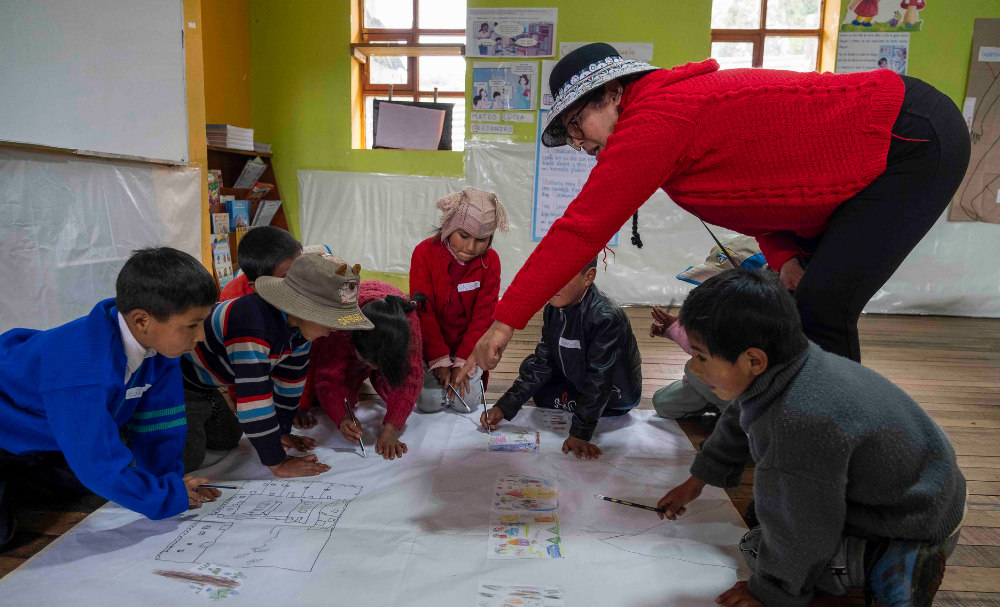
The story maps are created step by step. Together, the children draw paths, houses, fields, rivers, or mountains and explain what these places mean to them.
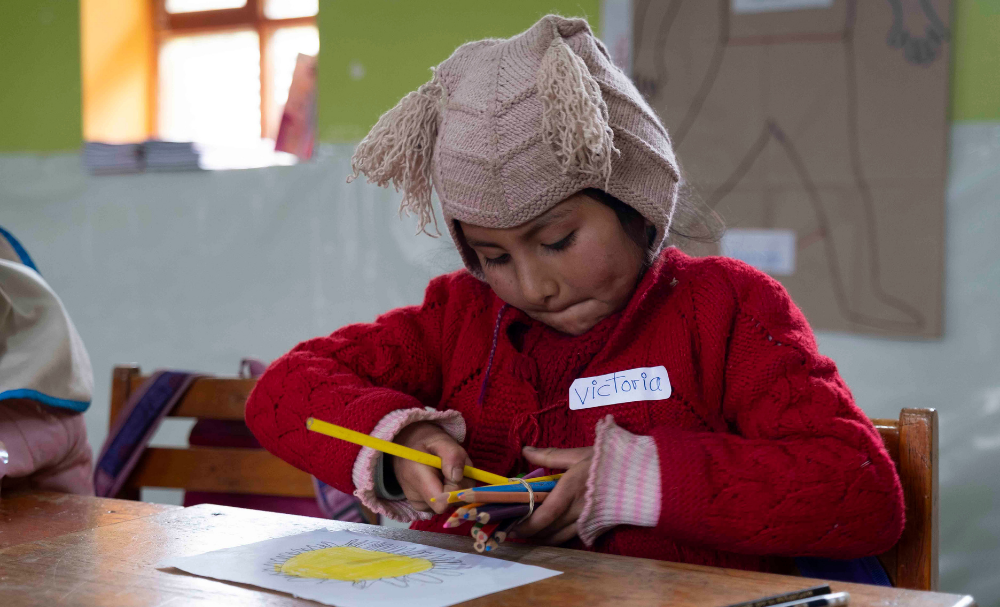
The maps reveal what the children associate with their surroundings. A river, a field, or a particular house may be linked, for them, to memories, experiences, or important people. In this way, the cards become personal representations of their village.
In the process, the children also contribute knowledge they have previously gathered in conversations with their parents or grandparents. Memories, experiences, and stories from the community are woven into the lessons. The cards link the learning process to the children’s own everyday lives and life in the village.

When designing the maps, the children work both individually and in groups. They draw, write, read, do maths, discuss, and tell each other about their experiences. Every child contributes their own ideas and knowledge.
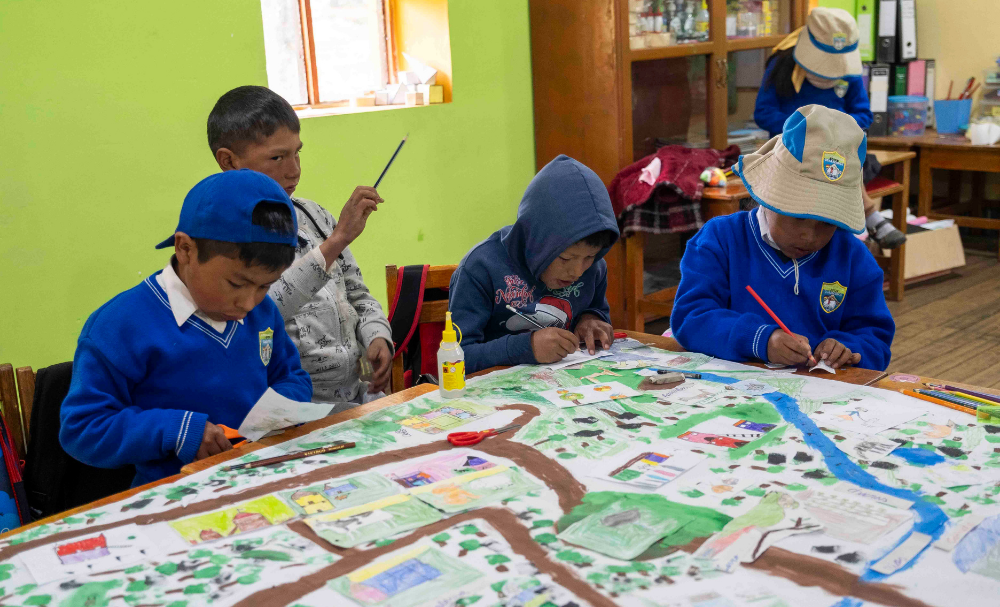
This results not only in colourful maps but also sparks conversations about their environment and community life, about working in the fields, village festivals, and family. Creative work and formal learning intertwine, fostering a range of skills simultaneously.

The children explore questions directly linked to their lives: Where does the water come from? What grows in the fields? Which places are important to the community? And which stories are passed down from one generation to the next?

With the younger children, periods of focused work alternate with group games, songs, or movement exercises. This keeps the children engaged and allows them to repeatedly get involved in new tasks.

Through play, they explore their surroundings, the history of their village, the animals, plants, and traditions. Learning thus becomes a shared experience that connects mind, body, and community.

The completed storytelling cards form the starting point for further discussions. Together, the children consider which topics are particularly important and which stories should be preserved.

They ask themselves what defines their community, what changes they are observing, and what challenges concern them. In doing so, they learn to organise their thoughts, listen to one another, and bring together different perspectives.

Radio programmes are created from selected topics. The children prepare their segments, conduct interviews, and narrate their own scripts. What was initially recorded on a card thus becomes a story that is acted out.

The children develop their own scenes from the stories. They take on different roles and act out the plot together. In doing so, they learn to express themselves, to listen, and to create a story together.

Using sounds, they have created themselves and a suitable soundscape, the children bring their stories to life. They learn to work creatively with language and sounds and to put their ideas into practice. The result is a radio play that reaches families and communities throughout the region via local radio stations.

Teachers also work with the storytelling cards. They reflect on the content produced and consider how they can incorporate it into their bilingual and multicultural lessons. The cards help them to design lessons that are more closely aligned with the children’s everyday lives.

They digitise the cards and build up a shared archive. In this way, the results from the workshops are incorporated into lessons and the further development of the method in the long term. What is created in the classroom thus has an impact beyond a single session.